Many will know the work of Martin Johnson Heade, who was born in Lumberville, Pennsylvania, in 1819, and died in St. Augustine, Florida, in 1904.
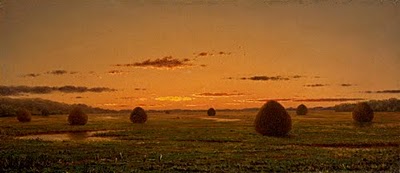
Although he also is known for paintings of hummingbirds and orchids, Heade's renown is primarily based upon his paintings of salt marshes. These marshes, along the Eastern seaboard of the United States, are filled during successive tides by salt water. Traditionally they were harvested for their hay which was made up into ricks, and balanced on piles throughout the marsh. It was these haystacks, diminishing toward the horizon, that became a principal motif for Heade.

But he particularly seems to have been drawn to the marshes in Rowley, Newbury, and Newburyport, on Boston's North Shore.
Tomorrow being Wednesday, it's time for a weekly plein air painting jaunt for me and a couple of painter friends. This week we are heading out just a few miles from home, to the Newbury marshes. In particular, the site is the road approaching Kent's Island, the one-time residence of author John P. Marquand. There is a winding marsh stream, and even a haystack replica, photographed this evening by my wife.

Below are a few more Heades, from the local area, to give you the flavor. It will certainly be a challenge tomorrow!


A photograph of the marsh, taken this evening.
.
